



Artificial intelligence in-house: 40 laboratory values become a plan people can read
The article walks through the four stages of preparation, names the limits of the methods and supports every statement with its source.
Read the articleAI in Medicine
A locally operated language model reads laboratory values, medical letters and imaging reports from several institutions, finds the connections between them and turns the material into a document that patient and physician read in …
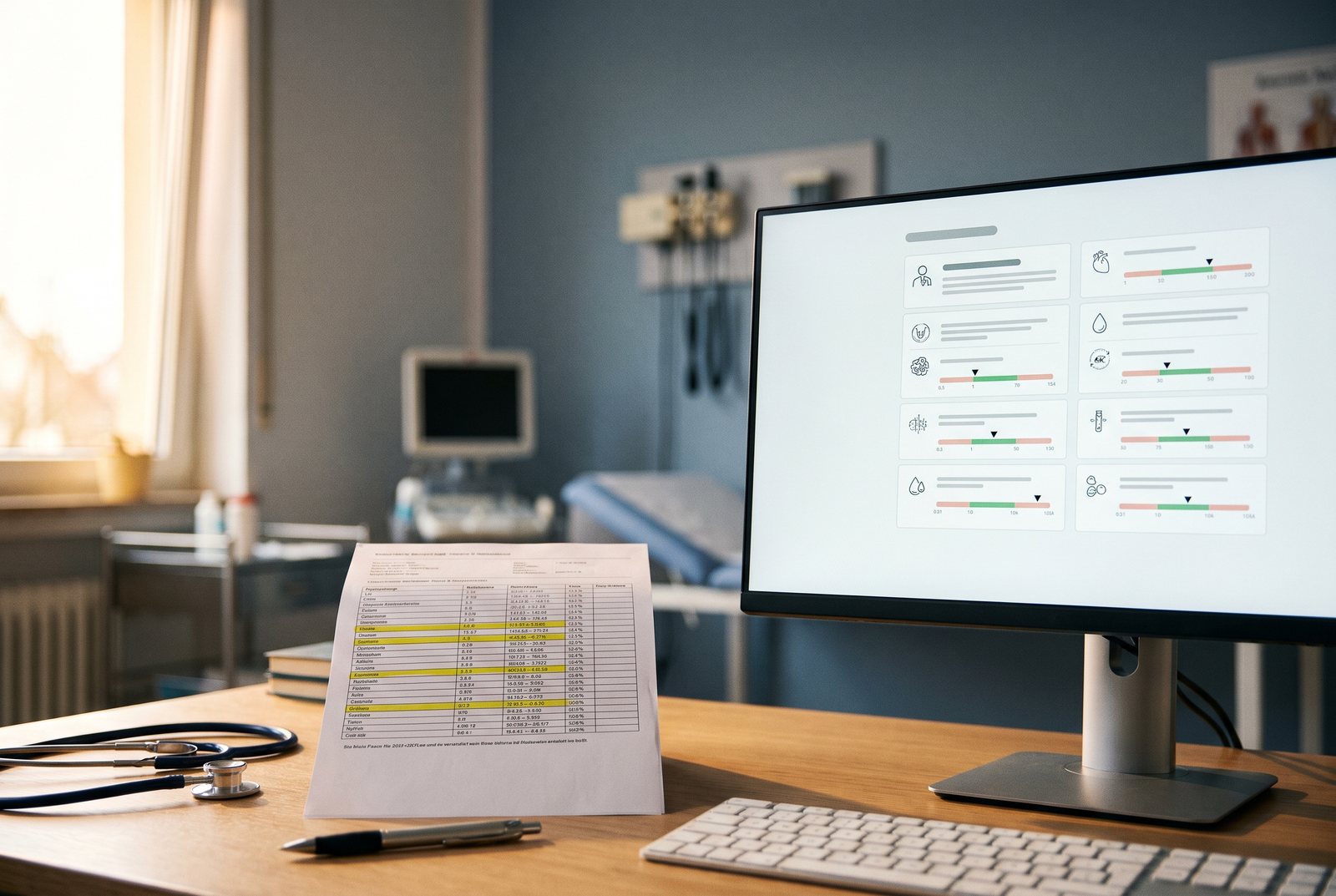
A laboratory report from a routine check-up contains around forty values, a few arrows in the margin and the reference range in the adjacent column. The patient takes away the impression that something is wrong. A standard consultation offers seven to ten minutes and covers the three most urgent points. The rest of the table stays unused, although it holds information that belongs together.
This is where a language model comes in, running on a machine inside the practice or the hospital. It links the values, checks each one against the reference range of the issuing laboratory, finds contradictions between two rows and puts the result into plain language. With several previous treating institutions involved, it places their statements side by side and marks the discrepancies.
Health data belongs to the special categories under Article 9 GDPR. Operating the model in the institution's own server room resolves that question at its root, because the findings never leave the building and no data processing agreement becomes necessary. Diagnosis and therapy remain a medical task, while searching, ordering and translating do not.
The technology is identical, the tailoring differs. Three groups ask for different results from the same material.
The preparation takes the searching and the translating off the practice. Medical time goes into checking the result instead of assembling the patient history.
Available individually:
Translation of findings into patient language, assessment of laboratory values against the reference intervals of the issuing laboratory, chronological consolidation of prior findings, a handout to take home, a list of questions for the next appointment, a checklist of sensible follow-up examinations.
For a first presentation with 98 pages of history, an ordered timeline with marked contradictions reads in a few minutes, a folder of copies does not. German hospitals have already proven the route via their own infrastructure.
Available individually:
Selection and operation of local models in the hospital data centre, connection to existing documentation, setting up the medical review as a named work step with documented sign-off, guidance on the deadlines of the EU AI Act and on the boundary towards the Medical Device Regulation.
Articles on AI in medicine rarely fail because of the topic and frequently because of verifiability. My texts rest on my own case work and on primary sources, and every figure carries its reference.
Available individually:
Articles and series on local language models, data protection and AI regulation in medicine, texts built on documented cases from my own work, talks and webinars, review of third-party AI texts for invented sources and wrong figures.

A research team at the Technical University of Munich gave 200 cancer patients their CT report, one group in the original and the other in an automatically simplified version produced by an open-source model on hospital-owned machines. Reading time dropped from seven minutes to two. 80 percent of patients rated the prepared version as understandable, compared with 9 percent for the original (Radiology 2025).
The benefit continues after the appointment, because telephone queries in the following week become fewer, and the questions that still arrive address the content instead of the translation of technical terms.
Technical terms from the report appear in ordinary words with the meaning behind them, and the patient arrives prepared, which makes the consultation shorter and calmer.
The handout names the scope of the examination and explains what the results say. The patient reads it at leisure without having to rely on the memory of a ten-minute conversation.
Every document ends with three to five questions for the respective specialty, so that scarce consultation time goes into the answers rather than into recounting the history.
The finding indicates the responsible specialty, and the patient arrives without the detour through two intermediate appointments at the place that can resolve the case.
All cases come from real preparations in a private setting. Names, dates of birth and identifying details have been changed.
A patient in his early fifties presents a laboratory report. Notable are a homocysteine of 18.8 µmol/l against a reference below 10, a folate of 5.1 ng/ml against a threshold of 5.4 and a total vitamin B12 of 233 pg/ml, where values above 400 are desirable. The model treats the three rows as one group, because the body breaks down homocysteine with the help of folate and vitamin B12. If either is missing, the value rises.
More revealing is the contradiction inside the same table. Next to the borderline total B12 sits a holotranscobalamin of 135.4 pmol/l, the active form available to the cell, and that value rests comfortably in the green zone against a threshold of 50. Looking at total B12 alone leads to an unnecessary course of supplements here. The model places both rows side by side and stumbles over the discrepancy, a patient holding a table does not.
An explained table changes nothing on its own. From the values, the existing medication and the living circumstances, a shopping list grew for the same patient and his partner, with product names, dosage, time of intake and price, around 100 euros in total and separated by person.
The patient takes rosuvastatin, and statins lower the body's own coenzyme Q10 level. The list names ubiquinol 100 mg with a meal containing fat. Alongside the high-dose vitamin D comes vitamin K2 in the MK7 form at 200 µg weekly, so that the additional calcium absorbed moves into the bones. A warning box names biotin, present in many B12 combination products, which distorts thyroid and cardiac markers in the next laboratory report.
For the partner, the living circumstances decided the matter. She eats nothing before 2 p.m., tolerates effervescent tablets poorly and takes an iron supplement. Vitamin C multiplies iron absorption, yet only works when taken at the same time. Her list therefore names a film-coated tablet at 2 p.m. together with the iron. A second part of the list names six products that offer nothing, each with one sentence of reasoning.
A patient in her early seventies with a gait disorder and muscle twitching presents at five hospitals in sequence and collects 98 pages of medical letters. One centre diagnoses late-onset multiple sclerosis and starts a baseline therapy, another explicitly declines to name the condition as MS. The patient holds both letters and understands neither.
The model reads the pages in a few minutes and places the statements of the five institutions side by side. One point surfaces that gets lost when reading them one after another. The revision of the international diagnostic criteria published in September 2025 requires three additional proofs from the age of 50 onwards or in the presence of vascular risk factors. Of those three, one is met in this patient, one is refuted by two examinations and one has never been obtained.
A stack of paper thereby turns into a concrete question for the next medical appointment. Judging that question remains a medical task, finding the discrepancy does not.
A patient in her early seventies has an abnormal stool test and a vitamin B12 of 303 ng/l. The first assessment assumes ongoing supplementation and reads the low level despite intake as a sign of an absorption disorder. A work-up across several appointments follows from that.
The resolution sits in the question about intake frequency. The patient takes the supplement once a month. With oral B12 products roughly 1 percent enters the body through passive diffusion, so 1,000 µg per month amount to about 10 µg against a daily requirement in the region of 4 µg. The low level explains itself entirely through the dosage, the work-up becomes unnecessary, and the solution consists of taking the same tablet daily. A model asks for dose, frequency and duration at every mention of a supplement, without forgetting that question in a full waiting room.
A patient with confirmed endometriosis has appointments in urology, gynaecology and ear, nose and throat medicine within ten days. Her records consist of laboratory findings, the report of an endometriosis centre and twelve months of correspondence.
From that the model built three separate consultation documents, each holding the material for its appointment. Urology received the bladder symptoms with the chronological course and the examinations already carried out, gynaecology the centre's report with the open recommendations, the ENT department the history of the rhinitis with the medication. Each document ends with three to five questions, and the effort for all three amounted to a few minutes of computing time plus a review.
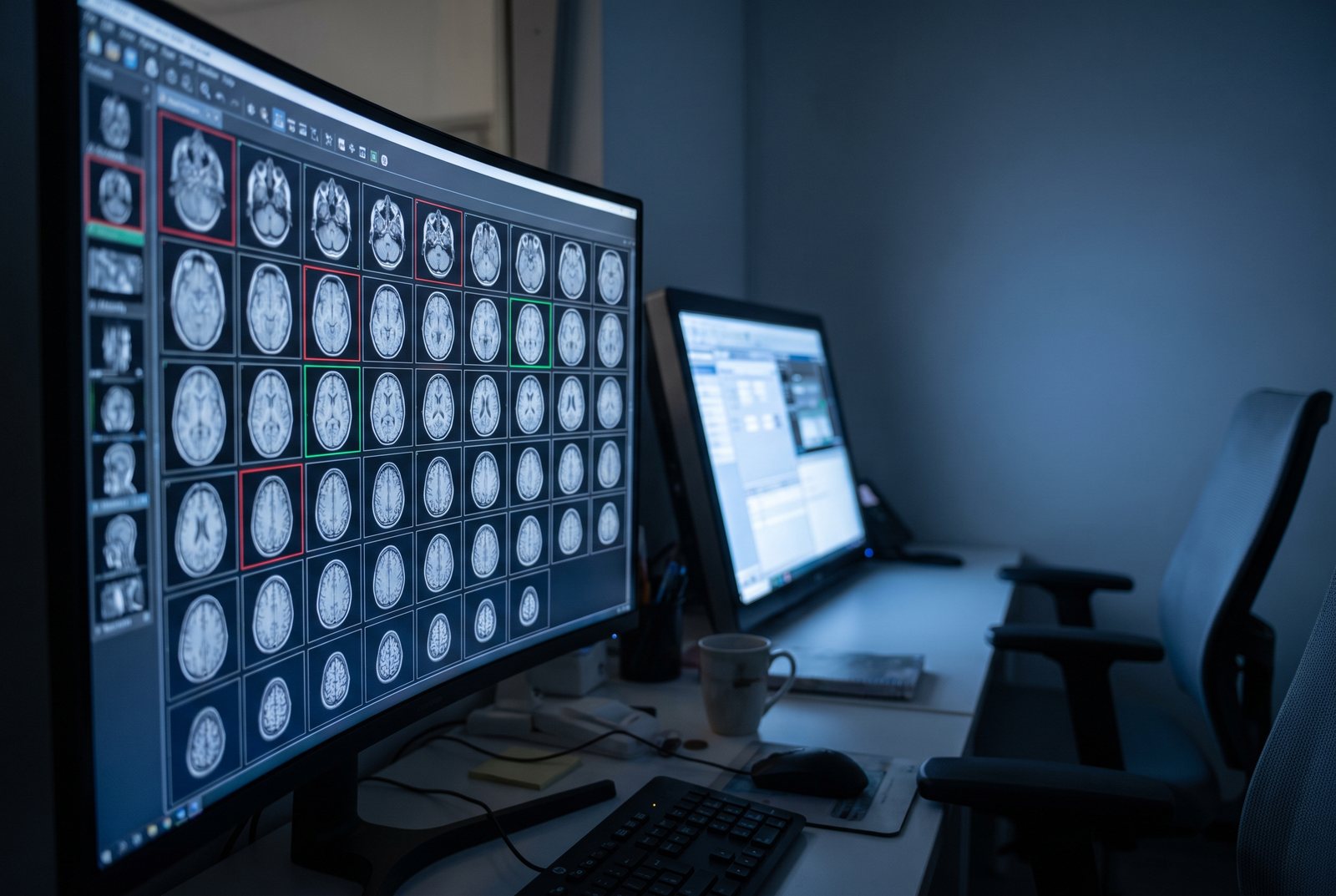
For the same patient, a 3 Tesla head scan followed in July 2026, 1,145 individual images across 16 series. From the dataset 19 image panels came together, among them pairs from two measurement sequences aligned through the patient coordinates with a measured residual offset of 0.3 to 2.3 mm. Four specialist analyses reviewed the images independently, after which a fact verifier checked against the guidelines and an arbiter examined the disputed points on the original dataset.
One reviewer suspected a signal increase in a temporal region, an indication of a hereditary vascular disease. Measuring on the original dataset with homologous sampling across the anatomical mirror plane produced a mean of 543 on the left and 543 on the right, alongside 1.0 against 0.9 percent lesion-bright voxels. The suspicion was cleared, because the demonstrable lesion of 405 mm³ sits on one side in a different location.
The preparation also found three deviations from older reports, among them two lesions from a volumetry that could not be reproduced and on which one of the required diagnostic regions depended. Three documents went to the patient and to the treating physicians, one with nine colour-marked illustrations in lay language, one as a technical statement, one as a full document with an action plan.
Effort rises with every stage, and so does the risk of error. A practice that starts at the first stage and stays there for six months has gained more than one that jumps straight to the fourth.
A single finding appears in understandable language. The original remains authoritative and sits alongside it, which keeps the risk of error lowest and makes the benefit measurable at once.
Every laboratory value receives its reference range, the deviation and one sentence on its meaning. The reference intervals come from the laboratory report itself, because laboratories work with different limits for the same parameter.
Several values and several findings come into relation with one another, and this produces the results that looking at each one alone never delivers. From this stage onwards the duty of medical review applies.
Recommendations, questions and proposals for further examinations follow from the overall picture. This stage never leaves the practice without medical sign-off.
A single model delivers a smooth, internally consistent answer, even on a thin basis. It reports no doubt, because it holds none. With a report of forty values that property carries more risk than with a single question. The most effective counter consists of posing the same task repeatedly and holding the results against each other.
In the preparation described above, four passes with different professional perspectives ran over the same material. A fifth received the explicit brief to refute the statements of the other four, with the default assumption that every claim is wrong until a primary source supports it. That pass took 25 professional statements apart and identified 11 of them as numerically wrong.
The same arrangement catches a second weakness. One research pass produced a source address that does not exist, and the specialist domain in question answered every invented path with status HTTP 200. Only a verification pass that calls every cited address itself and sends a deliberately false one as a control exposes such places. For the practice this means no double effort, because all passes run without human involvement. Time is only spent where the versions differ from one another.
Each of them can be ordered on its own, without taking the others along.
Laboratory reports, imaging and medical letters from different institutions come together ordered by date, and patient and physician see the course on a timeline instead of in a stack of paper.
Every value receives the reference interval of the issuing laboratory and a note on the direction of the deviation, which removes the manual comparison against shifting limits.
The report text appears in ordinary language, every technical term with a brief explanation, so that the patient can place his result before the appointment.
The document for the patient describes examination and result in his language, and the practice hands it out after medical sign-off without writing effort of its own.
The search delivers the relevant guideline passage and current work with its reference. The physician receives the state of research with a source instead of an assertion.
The available values indicate which further examinations contribute to clarification. The proposal serves as a checklist, the decision stays medical.
A list of questions per specialty and the assignment of the finding to the responsible department shorten the route. The patient arrives prepared.
Diverging statements from several institutions stand side by side and highlighted, so the physician finds the disputed passage in seconds instead of searching across several letters.
During the consultation an AI system listens and writes the documentation in the background. The physician speaks with the patient instead of typing. At the end a structured summary stands ready for the physician to check and approve. That leaves more time for the patient.


Patterns and trends over time emerge from the values of several examinations. A value that rises slowly, or a connection between two findings, becomes visible. The physician receives a structured overview that supports the assessment. The decision rests with the physician.
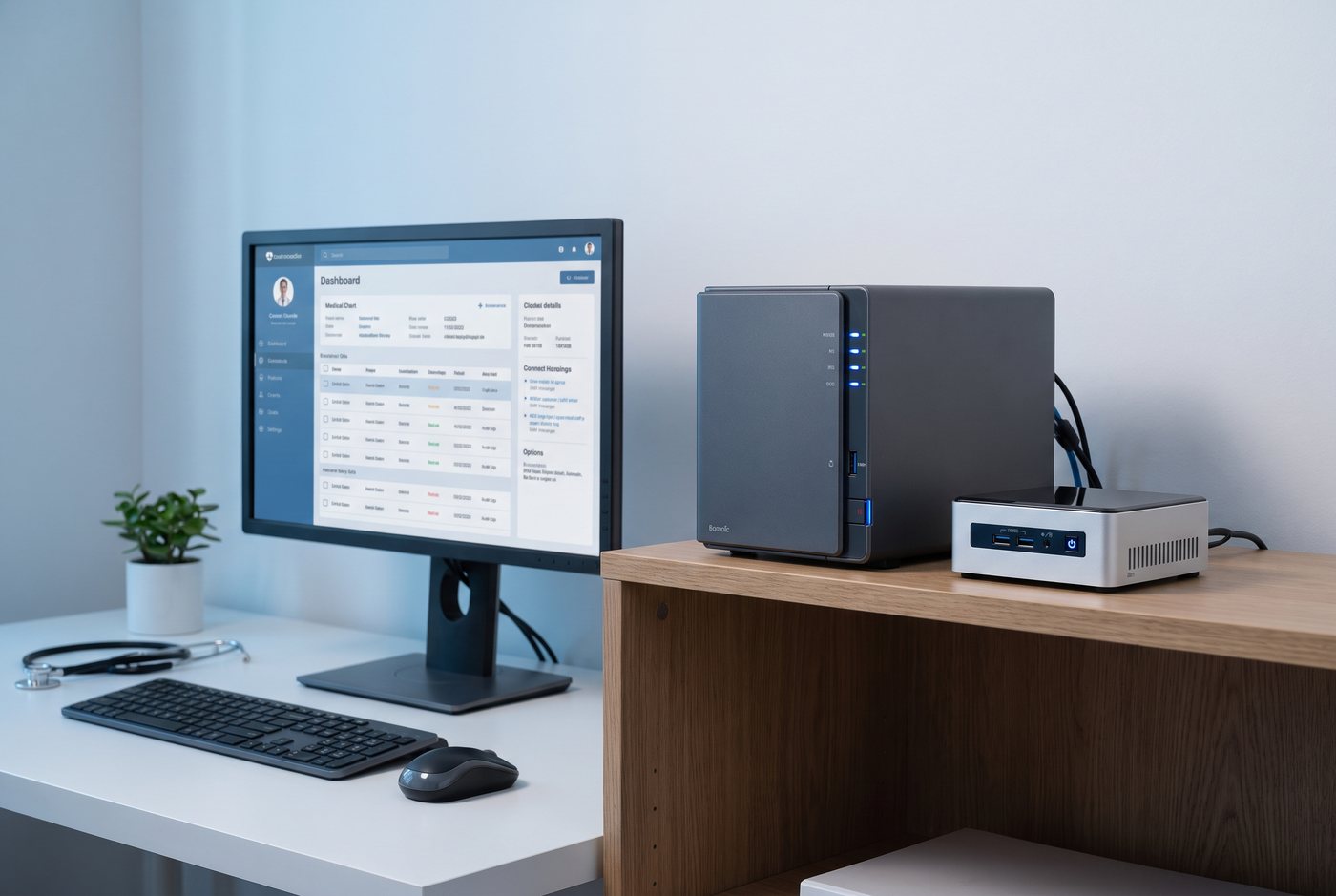
Processing health data is prohibited in principle under Article 9 GDPR and permitted only through narrowly defined exceptions, among them the consent of the data subject and treatment by practitioners bound to professional secrecy. A cloud service outside the institution's own control brings a justification burden that a practice with five employees can hardly carry.
The demands on the hardware have become manageable. Models with seven to fourteen billion parameters work on a current notebook with 32 GB of memory. Larger models of the Llama-3-70b class run quantised on two consumer graphics cards with 24 GB each. Freely available runtimes such as Ollama or LM Studio are sufficient.
A study from Bonn supplies the figure on the quality question. One commercial and two freely available models simplified 60 radiology reports there, after which 21 medical laypeople rated the outcome. Between GPT-4o and the open Llama-3-70b there was no statistically meaningful difference in comprehensibility, 4.4 against 4.3 out of 5 points, while the original scored 1.5 (European Radiology 2026).
An offer without named limits is of no use in medicine. Four points belong in every conversation before the first project.
The technical term is confabulation and describes an output that looks formally impeccable and is factually invented. Several passes working against each other lower the risk considerably, but they do not remove it. For every statement that triggers an action, the look into the primary source remains the only reliable safeguard.
In the Munich study, six percent of the simplified reports contained a factual error and seven percent omitted information from the original. With 100 prepared reports that means six faulty documents. Trained staff therefore check every output before handover, as a named work step with responsibility and documented sign-off.
Evaluating MRI or CT images for diagnostic purposes stays out of scope and requires systems approved under the Medical Device Regulation. A language model works on the text of the report and on the figures in the table. A model that rephrases existing findings and produces no diagnostic statement does not fall under the medical device definition on current interpretation.
The yield depends less on the chosen model than on the completeness of what it receives. In the preparation described above, the compilation came from a condensed case file, and six examinations long since carried out ended up in the evaluation as supposedly omitted. Only the full-text search in the 98 original pages resolved the error.
Articles on AI in medicine frequently consist of a row of studies and vendor claims. My texts start from my own case work, name the values, the computing time and the errors found, and bring studies in as evidence. Every figure carries its reference, every statement its date and primary source.
Topics for series and single articles are ready, among them the operation of local models in an institution's own data centre, the limits Article 9 GDPR imposes on cloud services, the deadlines of the EU AI Act, the boundary towards the Medical Device Regulation and the handling of invented sources in AI texts.
Editorial teams can draw on a second service. Third-party AI texts can be checked for invented source addresses, wrong figures and faulty citation chains, with a report naming every disputed passage together with the verified primary source.

Published
The journal Kosmetische Medizin published the article on preparing laboratory results. It describes the same approach as this page, worked through on a single case.

The article walks through the four stages of preparation, names the limits of the methods and supports every statement with its source.
Read the article„I find your interview really very good, and it makes you want to read the facts in the article.“
„On first skimming I already noticed your cross-reference to the motto of the issue. How elegant!“
Developments around AI in medicine, with an eye on data protection and practical benefit.
University Medical Center Hamburg-Eppendorf operates ARGO, a self-developed model trained on the de-identified documentation of more than seven million treatment cases and running throughout on its own infrastructure. The accompanying speech recognition system Orpheus has been in use since early 2025 at four university hospitals, more than 30 hospitals and over 200 outpatient facilities (Deutsches Ärzteblatt). A model on the institution's own premises makes the cloud dispensable.
A team from the University of Magdeburg and the Charité tested DeepSeek-V3 and R1 on 125 standardised patient cases. The freely available models delivered equivalent and in part better results than market-leading commercial systems and run inside isolated hospital IT. For data protection this means a local option without loss of quality.
A study at TU Munich simplified 200 oncological CT reports using the open-source model Llama 3.3 70B. Reading time fell from seven minutes to two and comprehension rose markedly, while six percent of the texts contained a factual error. That justifies medical review of every AI output.
Since October 2025, AI systems in pilot projects at Charité Berlin, University Hospital Mannheim and other institutions have listened to the physician-patient conversation and produced the documentation from it. The approach removes writing work from the physician and returns time to the patient.
Fraunhofer IPA is developing a RAG chatbot that links S3 guidelines, specialist literature and hospital-internal procedures with the data of the individual patient and delivers answers with source citations. Retrieval augmented generation couples the language model to verified sources and lowers the risk of invented statements.
AI in medical devices falls under the high-risk requirements of the EU AI Regulation, among them risk management, data governance and human oversight. For AI as a safety component of a regulated product the date is 02.08.2028, for standalone high-risk systems 02.12.2027 (Johner Institut). For practices and manufacturers this means predictable requirements for every medical AI in use.
I studied medical informatics and have worked as an IT and AI author for more than thirty years. The case preparations described on this page come from a private setting, with locally operated models on my own hardware and without any cloud involvement.
AI supports the preparation and the understanding, while diagnosis and therapy remain the physician's responsibility. From the combination of IT knowledge and a medical background I write and advise independently of vendors and close to practice.
The points come from completed cases. They describe the process, not a promise.
Individual values say little, their interplay says a lot. The preparation groups them into metabolic pathways instead of a list with arrows.
Findings sit with the family doctor, the specialist and the hospital. Only once combined does it show which examination has already been done and which is missing.
A dataset can be evaluated in full, from the series overview to the single slice. What can be ruled out is the most reliable part.
A second, independent pass regularly refutes claims from the first. What survives no check does not enter the document.
Health data never leaves the environment. The analysis runs on local hardware so that the question of processing does not arise.
Documentation emerges from the conversation while the appointment runs. The medical review stays the last step, not the first.
Practices and hospitals receive guidance on building local models and on preparing their findings. Publishers and trade media receive articles, series and talks. A short message with the project is enough.
Send a message